UNFPA, the United Nations Population Fund, is an international development agency that promotes the right of every woman, man and child to enjoy a life of health and equal opportunity. UNFPA supports countries in using population data for policies and programmes to reduce poverty and to ensure that every pregnancy is wanted, every birth is safe, every young person is free of HIV/AIDS, and every girl and woman is treated with dignity and respect. UNFPA - because everyone counts
|
World Population Day 2009 Responding to the Economic Crisis: Investing in Women’s Health is a Smart Choice HA NOI, 2 July 2009 – On the occasion of the 2009 World Population Day with a theme of “Responding to the Economic Crisis: Investing in Women is a Smart Choice”, the Ministry of Health and the United Nations in Viet Nam have made a call to keep on investing in women’s health and ensuring continued progress towards achieving the Millennium Development Goals, despite the recent global economic crisis.
Protecting the gains achieved in safe motherhood in Viet Nam
Clck here for the full human story. International Day of the Midwife 05 May, 2009 - Message of Thoraya Ahmed Obaid, UNFPA Executive Director The presence of a midwife at birth can mean the difference between life and death. Having a skilled professional at birth protects the life of the mother and the child by recognizing problems early, when the situation can still be controlled, and by intervening quickly. Every minute a woman dies in childbirth. And the presence of a midwife can save her. In 2008, UNFPA launched a new initiative with the International Confederation of Midwives to tackle the severe shortage of midwives in more than 30 developing countries. An additional 350,000 midwives are needed to improve maternal health, reduce child mortality and combat HIV. Addressing this shortage is also critical to achieving universal access to reproductive health by 2015. Our joint efforts are having results. For example in Laos, a country of more than 5 million people and only 86 midwives, a government plan to address maternal mortality includes strengthened midwifery training, as none currently exist. Today, on the International Day of the Midwife, I call on governments to contribute to this joint effort by providing funds to the Maternal Health Trust Fund and by supporting midwives in their communities. Bruce Campbell to visit UNFPA projects in Hoa Binh Province 03 April 2009 - Bruce Cambpell, UNFPA Representative in Viet Nam, finished today a two-day courtesy visit to Hoa Binh aiming to visit UNFPA funded interventions in the province and assess the challenges for the year. On the first day of the monitoring trip, Campbell along with Bui Thi Hong, Assistant to the Representative and Dao Khanh Tung, Programme Officer, Sexual and Reproductive Health Unit, met with Hoa Binh Provincial People’s Committee (PPC) and related departments, including the Department of Health, represented by the Director at the provincial level, Quach Dinh Thong, who debriefed on the goals of the Department in the area of Sexual and Reproductive Health. Click here for the full article. Gender Equality not yet sustainable Vietnam News featured on March 7 Bruce Campbell, UNFPA Representative, stating that women’s role in the country’s economy is high. According to Campbell, Viet Nam has a strong record on the promotion of gender equality and women’s empowerment. “The record is manifested in the constitution and legal frameworks, particularly two recent laws, the 2006 Law on Gender Equality and the 2007 Law on Domestic Violence Prevention and Control”, UNFPA Representative said. However, the playing field is not level, and women are not yet able to compete on equal terms with men. “Men benefit more from jobs with decision-making power and status. Issues such as relatively lower wages and higher wage gaps in the private sector will impact more and more women in the future”, he concluded. Click here to see the full article: http://vietnamnews.vnanet.vn/showarticle.php?num=08SOC07030 Launching Ceremony of the State of World Population 2008 Reaching Common Ground: Culture, Gender and Human Rights
Viet Nam to tighten two-child rule Ha Noi, 20 Nov, 2008 - AFP reported on 20 November that the Vietnamese cabinet agreed on a draft amendment that would turn the two-child rule into law once it is passed by the National Assembly. According to official statistics released by the General Office for Population and Family Planning, number of third-child births increased 10% in the same period last year. Ms Tran Thi Van, UNFPA Assistant Representative in Vietnam, told AFP the new third-child figures did not match the UN data, which had indicated a downward trend in recent years. Viet Nam debates two child policy Radio Australia reported on 21 November that Vietnam's government is considering a return to a two child policy in an attempt to control population growth. Ian Howie, UNFPA Representative, had a three minute interview with Radio Australia.Click here: http://www.radioaustralia.net.au/programguide/stories/
|
|
||||||||||||||||||||||
The Vietnamese version of the website is under construction! Trang web phần tiếng Việt đang được cập nhật! |
||||||||||||||||||||||||
| UNFPA Viet Nam | Contact Information | Report a problem with this site | |


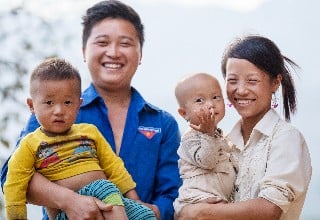
Hang Kia (Mai Chau District, Hoa Binh Province), 2 July – When Kha Y Khua gave birth to her first child 13
years ago, it was not common for H’Mong people to deliver at health facilities. Located in hard-to-reach areas,
this ethnic minority group is known for its strong cultural traditions, such as giving birth at home with family
members as birth attendants. Though this practice still persists in some of the most isolated villages of Hang Kia
Commune and in other remote provinces, in Hoa Binh things started to change some time ago.
The State of World Population 2008 from UNFPA is published a few days ahead of the International Day for Tolerance, 16 November, which calls for respect for human rights and fundamental freedoms for all without any distinction of race, sex, language or religion. It also coincides with the 60th anniversary year of the Universal Declaration of Human Rights. The report calls for culturally sensitive approaches to development, to promote human rights in general, and women’s rights in particular.